Gnathological Overlays for Children
At Dental Date TMJ Institute, gnathological overlays are designed with careful consideration of a child’s facial skeletal growth and development.
This is a high-precision functional approach aimed at correct positioning of the lower jaw and the formation of a physiologically proper bite height.
Formation of the correct position of the lower jaw
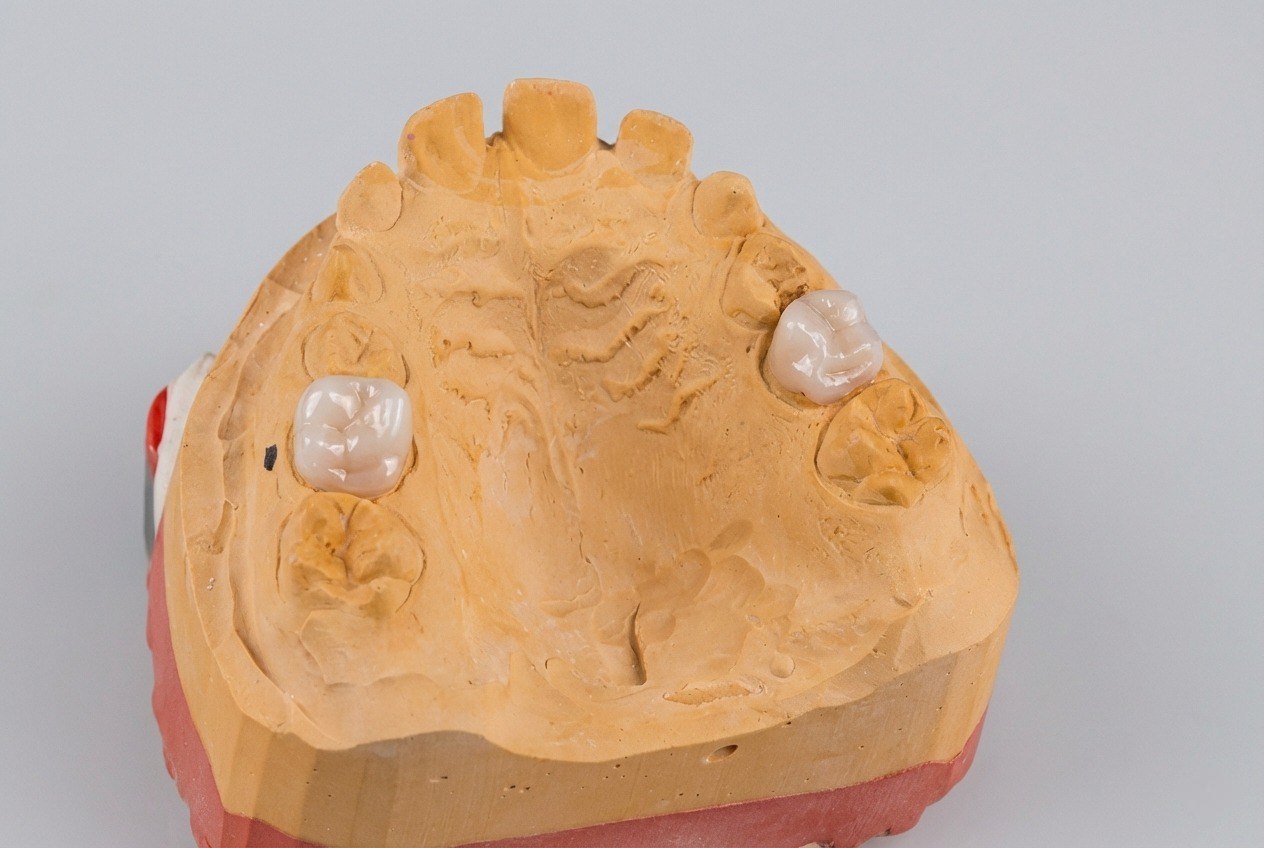
Gnathological overlays are functional appliances that may visually resemble small crown-like elements, yet their purpose is fundamentally different from restorative or aesthetic solutions. Their primary role is to guide the lower jaw into a physiologically correct position during a child’s active growth phase.
Rather than focusing on tooth shape, these overlays work at a functional level, influencing jaw positioning and coordination within the entire craniofacial system.
Proper alignment of the lower jaw supports the formation of an optimal bite height, helps distribute functional loads evenly, and promotes balanced skeletal development in accordance with the child’s individual anatomy.
This approach views gnathological overlays as part of a comprehensive functional strategy, aimed at supporting harmonious growth, long-term bite stability, and healthy interaction between the jaws, muscles, and temporomandibular joints.
Fixation of Overlays and Child Comfort
Gnathological overlays are designed in accordance with the physiological characteristics of a child’s bite and are fixed in a way that does not interfere with daily activities or require constant supervision from parents. Both the design and fixation method ensure stable and continuous function throughout the treatment period.
Placement on primary teeth only
Overlays are fixed exclusively on primary teeth, allowing safe functional guidance during growth without affecting the permanent dentition.
Non-removable design
The fixed construction eliminates the need for removal, reducing the risk of improper use and ensuring consistent therapeutic action.
No daily monitoring required
Children do not need to manage the appliance themselves, and parents are not required to perform regular checks.
Comfort during everyday activities
The overlays are adapted for normal speech, chewing, and daily routines, providing a comfortable experience for the child.
Natural completion of treatment
As the bite changes physiologically, primary teeth exfoliate naturally together with the overlays, without additional procedures.
Diagnosis and Treatment Planning
The use of gnathological overlays is always based on a thorough diagnostic assessment. In children, the jaw system is actively developing, which is why evaluation is performed using a comprehensive approach rather than a single parameter.
The diagnostic phase allows the specialist to:
Assess current jaw positioning
The relationship between the upper and lower jaws is analyzed in relation to the child’s developmental stage.
Evaluate functional joint and muscle activity
Attention is given to how the jaws function during movement and loading, not only in a static position.
Identify individual growth characteristics
Each child follows a unique growth pattern, and treatment planning must be tailored accordingly.
Determine the optimal timing for intervention
In some cases, early correction is appropriate; in others, monitoring until a more suitable growth phase is recommended.
Sign up online
Clinical Methods at DentalDate
In pediatric patients, it is essential not only to identify functional characteristics but also to accurately assess growth patterns and anticipate craniofacial development. A comprehensive instrumental approach is applied to obtain objective data and ensure precise treatment planning.
The diagnostic protocol includes:
Gamma facebow analysis
This method records the spatial position of the jaws and transfers the child’s individual parameters into the laboratory planning stage.
Individual laboratory fabrication
Each overlay is manufactured on a personalized basis, reflecting the diagnostic findings and anatomical characteristics of the patient.
Cephalometric radiography
Used to analyze jaw relationships, growth direction, and skeletal proportions over time.
Computed tomography of the temporomandibular joint
Allows detailed assessment of joint structures and their functional interaction, providing reliable data for clinical decision-making.
When and Why to Schedule a Consultation
An initial consultation is conducted not for the immediate start of treatment, but to professionally assess how the bite and the child’s craniofacial system are developing. In childhood, many changes occur gradually and are not accompanied by noticeable symptoms, which means that visual signs alone do not always reflect the true functional situation.
The most appropriate time for a first consultation is typically around the age of 5–6 years, when jaw growth enters an active phase and stable developmental patterns begin to form. An assessment at this stage makes it possible to determine whether development corresponds to age-related norms, identify functional deviations at an early stage, and evaluate whether observation or intervention may be required.
The primary purpose of the consultation is to establish a clear clinical reference point. Parents receive an objective understanding of the current condition, possible developmental scenarios, and medically grounded recommendations for next steps. In some cases, regular monitoring without intervention is sufficient; in others, it is important to identify the optimal timing for correction, when it can be carried out in the most physiological and predictable way.
Early consultation also helps reduce the likelihood of more complex interventions later on, as it allows functional issues to be identified and addressed while growth remains adaptable. It enables the development of an individualized monitoring plan that reflects the specific growth dynamics of the child.
A consultation should therefore be viewed as a stage of clinical evaluation and planning. It supports informed decision-making based on objective findings and growth dynamics, rather than external appearance or subjective concerns.

Benefits of the DentalDate TMJ Institute approach
Comprehensive in-house diagnostics
All key diagnostic procedures and clinical evaluations are performed within the clinic, ensuring consistency and accuracy.
High-precision treatment planning
Diagnostic data is used to accurately define jaw positioning and anticipate craniofacial development.
Individually fabricated gnathological appliances
Each appliance is custom-made for the patient, avoiding standardized or generic solutions.
Calm, child-focused clinical environment
The care process is designed to provide comfort and clarity for both children and their parents throughout treatment.
Modern clinical infrastructure
The space, equipment, and digital solutions are designed to ensure precise and comfortable work with complex clinical cases.
International Standard of Patient Experience
Appointment scheduling, patient support, and communication are structured to meet the expectations of an international clientele and the standards of high-end private healthcare.


Doctors
All doctors







Reviews
Video Reviews




How Pediatric Gnathology Differs from Adult Gnathology
Pediatric gnathology differs fundamentally from adult care because it focuses on a system that is still actively developing rather than one that has already fully formed. In children, the craniofacial system is dynamic, and the clinical goal is not to correct fixed abnormalities but to assess growth direction and guide development at the appropriate time.
Unlike adult gnathology, where treatment often must adapt to established structural limitations, pediatric patients retain a high capacity for physiological adaptation. This allows for gentler, more flexible clinical strategies that take into account age, growth rate, and individual developmental patterns. Decisions are made with a long-term perspective, considering how the system will evolve rather than focusing solely on its current state.
Planning in pediatric gnathology therefore requires particular precision in timing. Choosing when to intervene, observe, or reassess is just as important as determining the treatment approach itself. The emphasis is placed on supporting balanced functional development over time, rather than achieving an immediate visual outcome.
What Happens When Functional Issues Are Left Unaddressed
Functional irregularities within the craniofacial system do not always present with obvious symptoms in children and often develop gradually. In early stages, these changes may appear minor or temporary, but as growth continues, such patterns can become more stable and influence bite formation and functional coordination.
As a child grows, compensatory mechanisms may partially adapt to these imbalances. However, this adaptation is not always optimal from a functional standpoint and may complicate future correction. Over time, this can reduce predictability of treatment outcomes and increase the need for more extensive or combined interventions.
When growth is complete, the opportunity for gentle, physiological correction becomes significantly more limited. Early assessment and monitoring therefore play a preventive role, allowing functional characteristics to be identified and managed while development remains adaptable. In this context, timely evaluation is not about initiating treatment prematurely, but about preserving options and avoiding more complex clinical scenarios later on.