


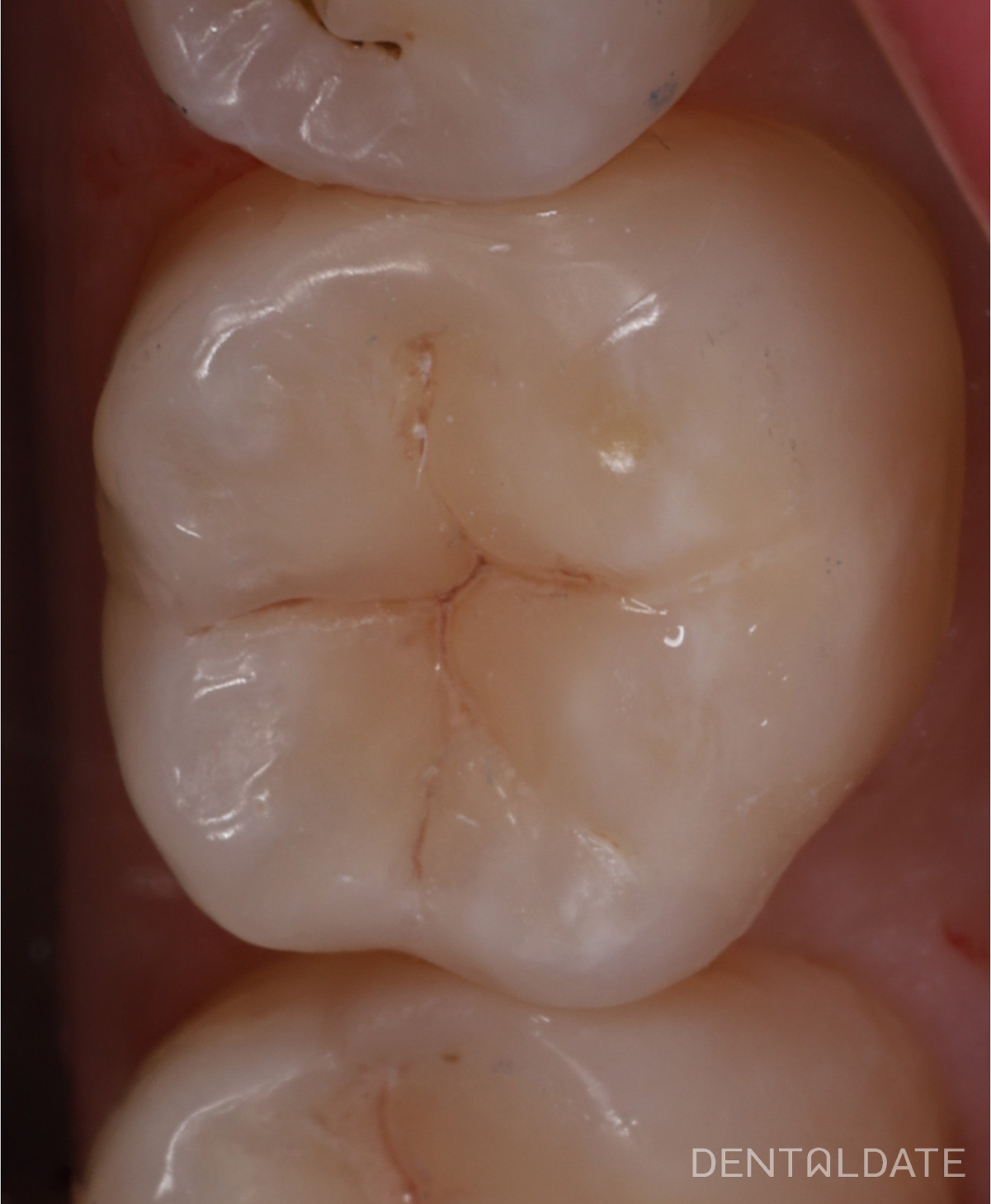

The patient was concerned about an old filling on the lower molar 4.6, which no longer performed its function properly. In addition, caries was detected on the contact surface of the adjacent tooth 4.5.
Why this is important
Many patients believe that a small filling can last for years without issues. However, old materials gradually lose their seal, and caries on the contact surfaces between teeth often remain unnoticed for a long time. This leads to food impaction, sensitivity while eating, and rapid tooth destruction.
Examination and treatment plan
The dentist diagnosed secondary caries on tooth 4.6 and a carious lesion on the contact surface of tooth 4.5.
It was decided to carry out treatment with minimal preparation, preserving as much healthy tissue as possible.
Treatment steps
- The old filling on tooth 4.6 was completely removed, and caries on the contact surface was treated.
- On tooth 4.5, preparation of the distal surface (toward 4.6) was performed.
- Modern composite materials were used for restoration, allowing preservation of the marginal ridge and the natural tooth anatomy.
Result
The patient regained full chewing function. Food no longer gets stuck between the teeth, sensitivity while eating disappeared, and the restored teeth now look natural and aesthetic.
What patients should know
Even if a tooth looks “fine,” an old filling or hidden caries can cause serious problems. The earlier an old filling is replaced and caries on chewing teeth are treated, the higher the chances of preserving your natural tooth structure and avoiding complex procedures in the future.


