


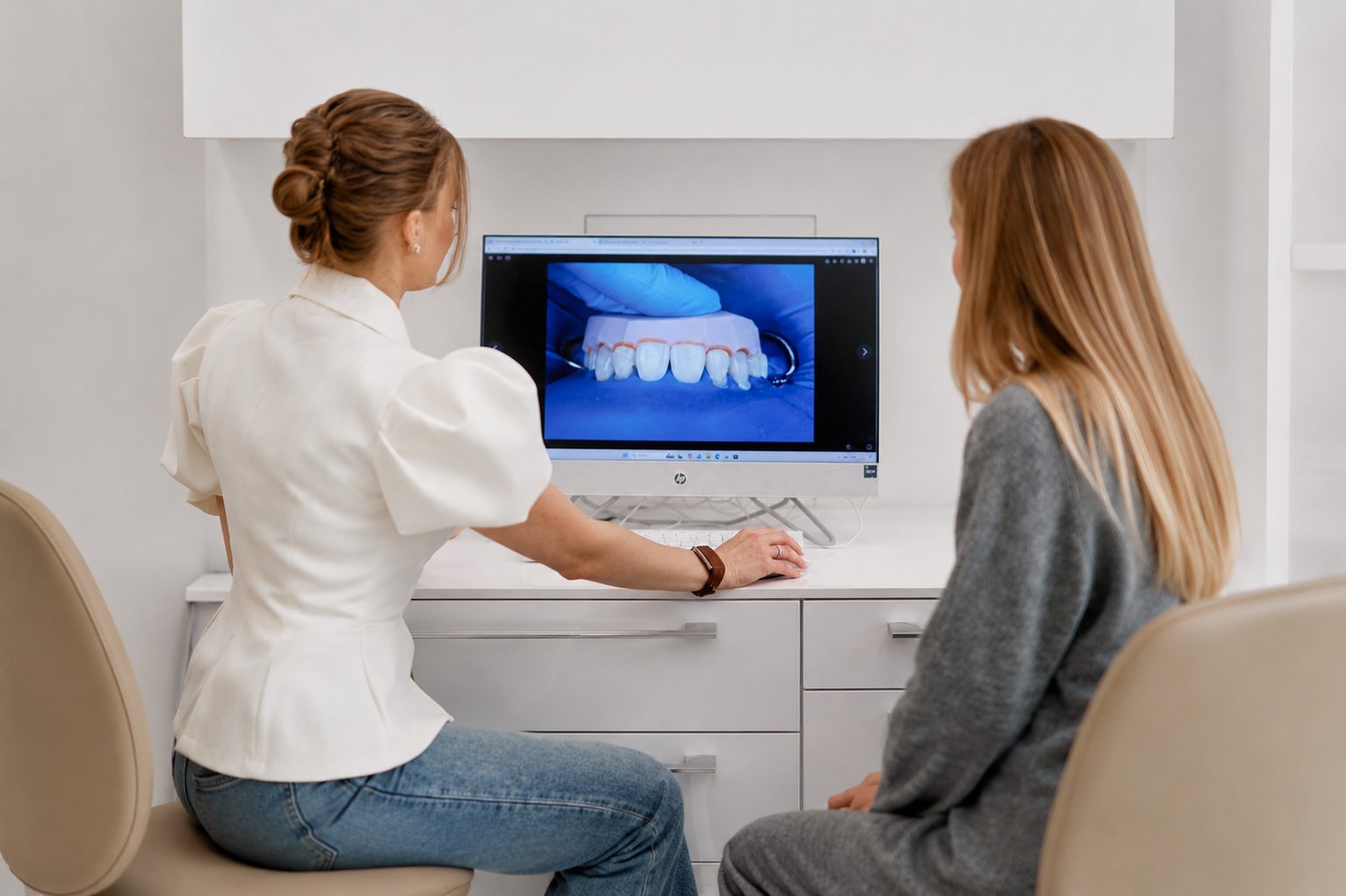
Many patients seek help only when jaw clicking begins to be accompanied by pain, limited mouth opening, or constant tension in the facial muscles. However, treatment of the temporomandibular joint is not limited to one procedure or one appliance. To achieve a long-term result, it is necessary to go through several consecutive stages, each of which solves a specific clinical task.
Modern TMJ treatment in Dubai is based on eliminating the cause of the disorder, not just its symptoms. That is why treatment does not begin with a splint or braces, but with a complete functional diagnosis that helps determine why the joint has stopped working properly.
A well-structured protocol helps not only reduce clicking and discomfort, but also create the conditions for long-term stability.
Step 1. Consultation with a Gnathologist
The first stage of treatment begins with a consultation with a gnathologist.
During the appointment, the doctor carefully analyzes the patient’s complaints, assesses the condition of the dentofacial system, evaluates the function of the chewing muscles, and studies how the temporomandibular joint works.
Many patients come with complaints of jaw clicking, pain in the jaw joint near the ear, tinnitus, headaches, or tension in the facial muscles. At first glance, these symptoms may seem unrelated, but a comprehensive assessment helps identify the possible connection between them.
During the consultation, the patient receives a preliminary understanding of the situation, recommendations for further examination, and information about possible treatment options.
Step 2. TMJ Diagnosis
After the initial examination, instrumental diagnostics are performed.
Without a precise understanding of the position of the articular disc, the movement pattern of the condylar heads, and the functional characteristics of the lower jaw, it is impossible to create an effective treatment plan.
The diagnostic process may include:
- TMJ condylography;
- computed tomography (CT);
- cephalometric X-ray;
- photo protocol;
- MRI of the joints if necessary.
Each examination has its own purpose. Computed tomography helps assess bone structures, MRI shows the condition of the articular disc and soft tissues, while condylography makes it possible to analyze joint movement in real time.
At this stage, the degree of joint dysfunction is determined, the causes of symptoms are identified, and the prognosis for future treatment is formed.
Step 3. Determining the Correct Position of the Lower Jaw
After diagnosis, it is necessary to determine the position of the lower jaw in which the joint can function most physiologically.
A special diagnostic procedure called a test bite is used for this purpose.
During the examination, the doctor models a therapeutic position of the lower jaw and evaluates how the joints and muscles respond to the changes.
For many patients, this stage becomes the first clear confirmation that the problem is truly related to the TMJ. Often, during the test, clicking becomes less pronounced, chewing muscle tension decreases, and the patient feels freer movement of the lower jaw.
The information obtained becomes the basis for further treatment.
Step 4. Splint Therapy
The next stage is splint therapy.
This is one of the most important components of conservative TMJ treatment, because it creates the conditions needed to restore proper function of the joint structures.
An individual splint is fabricated based on diagnostic data and the calculated therapeutic position of the lower jaw.
The main goals of the splint are:
- stabilization of joint function;
- reduction of overload on the joint surfaces;
- decrease in muscle tension;
- improvement of articular disc position;
- reduction of pain;
- creation of conditions for restoring TMJ function.
It is important to understand that splint therapy is different from using standard mouthguards. Each appliance is made individually and is part of a broader treatment protocol.
In many cases, this is the stage where patients notice a significant reduction in symptoms associated with joint dysfunction, including jaw clicking, muscle tension, and discomfort while chewing.
Step 5. Orthodontic Treatment
After the joint condition has been stabilized, the achieved result must be maintained.
If treatment stops at the splint stage, there is a risk that the lower jaw may gradually return to its previous position. That is why orthodontic treatment often becomes the next stage.
Depending on the clinical situation, the following may be used:
- braces;
- clear aligners;
- additional orthodontic appliances.
The main goal of this stage is not only to align the teeth, but also to create a stable bite that supports the correct position of the lower jaw and the joint.
That is why modern TMJ treatment considers the orthodontic stage an important part of long-term result stabilization.
Step 6. Final Stabilization of the Result
After the active phase of treatment is completed, the achieved changes are assessed.
The doctor evaluates the condition of the joint, analyzes muscle function, and checks the stability of the lower jaw position.
To monitor the result, the following may be used:
- clinical examination;
- repeated condylography;
- bite analysis;
- additional examinations if necessary.
In some cases, repeated MRI may be performed to confirm the condition of the articular disc and surrounding structures.
This approach helps ensure that treatment has led not only to the disappearance of symptoms, but also to restoration of proper joint function.
Why It Is Important Not Only to Remove the Clicking, but Also to Maintain the Result
Eliminating symptoms is only one part of treatment.
Many patients believe that if the clicking has disappeared or the pain has decreased, the problem has been fully resolved. Functional dentistry looks at the situation more deeply.
If stable lower jaw position is not maintained after splint therapy, the joint may gradually return to its previous pattern of function.
That is why orthodontic correction or other methods of maintaining the result often become an essential part of treatment.
This approach helps reduce the risk of recurrent clicking, pain, overload of the joint structures, and further progression of the disorder.
Why Symptoms May Return After Treatment in Other Clinics
One of the most common causes of relapse is treatment focused only on symptoms.
If therapy is aimed only at relieving pain or achieving temporary improvement, but does not address the position of the lower jaw and joint function, symptoms may return after some time.
Sometimes patients experience relief for several months or even years, but without full stabilization of the underlying cause, the risk of recurring complaints remains.
That is why modern TMJ treatment should include a complete cycle of care:
- diagnosis;
- determination of the therapeutic lower jaw position;
- splint therapy;
- orthodontic correction if necessary;
- result monitoring.
Only this approach makes it possible to expect long-term stability.
How Long Does TMJ Treatment Take?
The duration of treatment is always determined individually.
Timing depends on the degree of joint dysfunction, the condition of the articular disc, the severity of bite changes, and the presence of associated dental problems.
In some patients, the main symptoms can be significantly reduced within the first months of treatment. In more complex cases, the process may take much longer, especially if an orthodontic stage is required.
The main goal is not to eliminate symptoms as quickly as possible, but to achieve a stable and predictable result.
What the Patient Receives After Treatment
Properly planned and performed treatment makes it possible to solve several important tasks and restore normal function of the dentofacial system.
After completing treatment, the patient receives:
- an accurate TMJ diagnosis;
- analysis of the condition of the articular disc;
- comprehensive diagnosis of the joint and bite;
- an individual treatment plan;
- monitoring of the result at every stage;
- stable lower jaw position;
- reduced risk of TMJ arthrosis;
- a long-term result without surgery.
Our goal is not only to eliminate individual symptoms. The main objective of treatment is to restore joint health, preserve its function, prevent further destruction of joint structures, and provide long-term comfort for the patient.
