Initial Diagnostics and Treatment Planning
Before starting treatment, a comprehensive diagnostic evaluation was performed, including:
- assessment of occlusion and vertical dimension of occlusion;
- analysis of the dental arches;
- evaluation of mandibular movements using condylography;
- assessment of the condition of the gingival soft tissues.
The diagnostics showed that achieving a high-quality aesthetic result required not only changing the shape and color of the teeth, but also correcting bite parameters.
Bite Height Correction and Soft Tissue Preparation
At the preparatory stage, work was carried out to correct the vertical dimension of occlusion.
This stage is essential in full aesthetic rehabilitation, as jaw position directly affects:
- the future smile line;
- uniformity of occlusal contacts;
- proper fit of veneers;
- long-term stability of the result.
Soft tissue correction was also performed to create a neat, symmetrical gingival contour. This ensures proper adaptation of the definitive restorations and significantly improves the visual outcome.
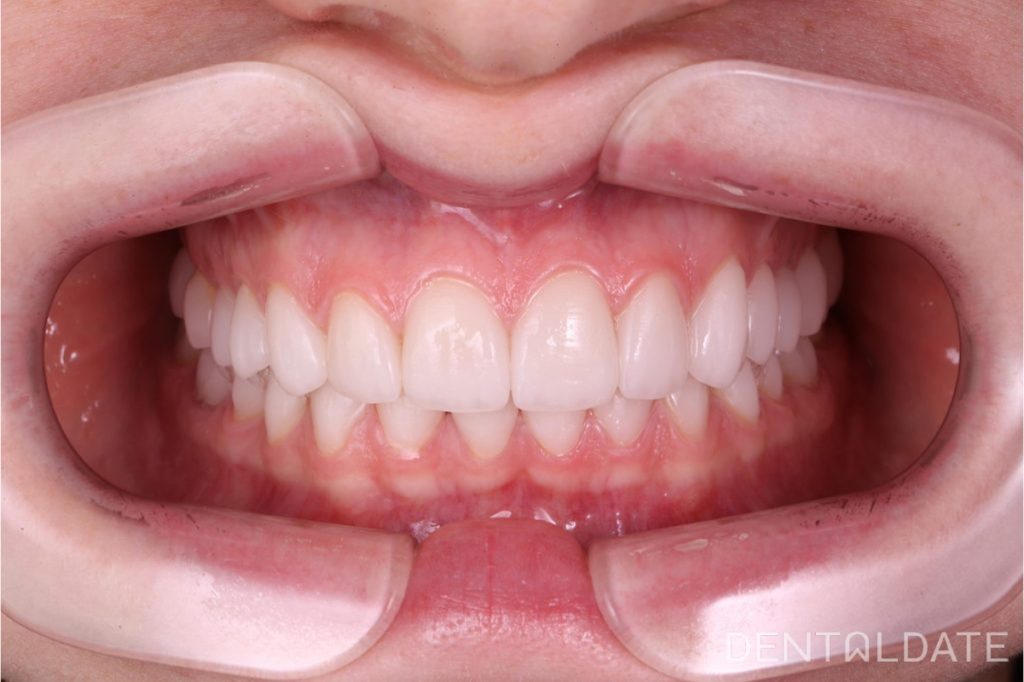
Fabrication and Placement of 28 Thin-Walled Ceramic Veneers
After stabilization of the bite and preparation of the tissues, 28 thin-walled ceramic veneers were fabricated.
The following parameters were taken into account:
- the natural shade of the enamel;
- the desired brightness of the smile;
- translucency of the incisal edge;
- anatomical tooth form, considering interdental spaces.
Thin-walled veneers allow maximum preservation of natural tooth structure while achieving high precision of fit with minimal tooth preparation.
Changes Achieved After Treatment
After veneer placement, it was possible to:
- completely close interdental spaces;
- harmonize and align tooth shapes;
- improve aesthetic symmetry;
- correct the shade and make the smile lighter;
- achieve an even and cohesive dental arch;
- ensure precise occlusal contacts thanks to bite correction.
The final result appears natural due to the semi-translucent incisal edges and carefully selected tooth color.
Why Bite Correction and Veneers Are Combined in Such Cases
When a patient presents with:
- interdental spaces;
- asymmetry of the dental arch;
- altered vertical dimension of occlusion,
veneers alone are not sufficient to fully resolve the problem.
Bite correction is necessary to:
- ensure proper seating of restorations;
- distribute occlusal load evenly;
- prevent chipping and overload;
- ensure long-term durability of the result.
After this stage, veneers serve as the final aesthetic component of treatment.
The DentalDate Approach to Comprehensive Aesthetic Rehabilitation
At DentalDate, aesthetic and functional rehabilitation is carried out according to a clearly structured protocol, adapted to each specific clinical case. The main stages include:
- Advanced diagnostics – occlusal analysis, evaluation of jaw position, assessment of soft tissues, photographic protocol, and digital modeling;
- Planning of vertical dimension and smile line, with functional studies such as condylography when indicated;
- Tissue preparation – gingival contour correction, temporary restorations, and occlusal control;
- Fabrication of definitive restorations – ranging from individual veneers to full-arch rehabilitations, with the number of restorations determined by the clinical objectives;
- Final fixation and adjustment of contacts to ensure stability and proper load distribution.
This approach allows for predictable aesthetic outcomes while maintaining correct dental function, regardless of the scope of treatment – whether a few veneers or a complete reconstruction.