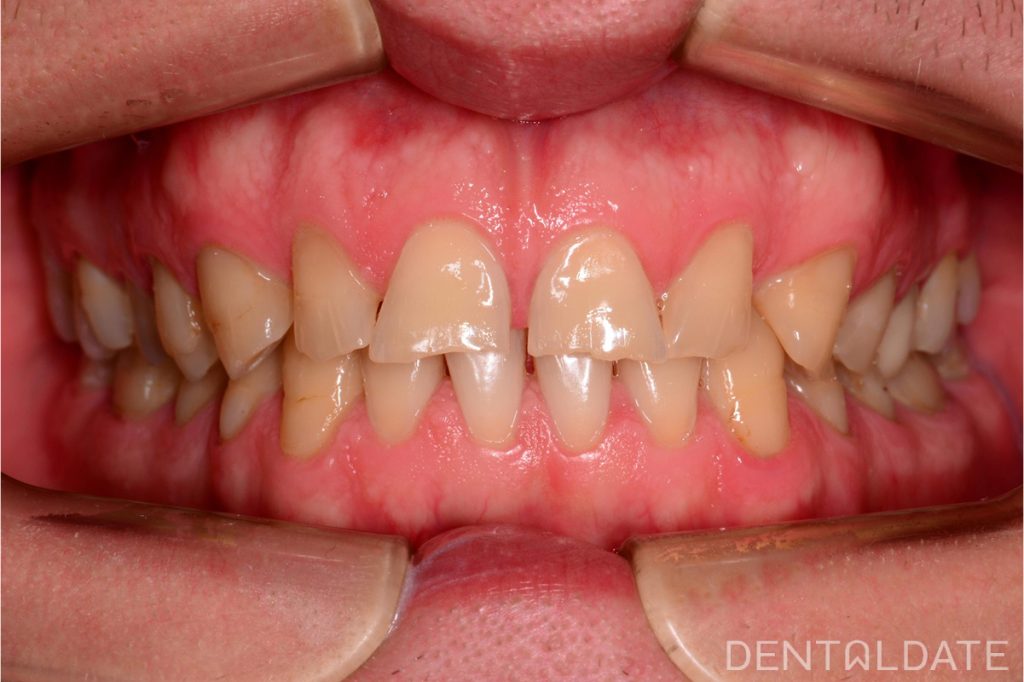
Patient’s Chief Complaint
Clinical examination revealed:
- multiple enamel chips;
- localized destruction of the coronal tooth structure;
- pronounced tooth wear;
- reduced vertical dimension of occlusion;
- mismatch with both aesthetic and functional standards.
In such a clinical situation, a comprehensive approach to restoring tooth shape, vertical dimension, and overall function is required. These issues cannot be corrected with isolated or single restorations.
Restorations Fabricated
To restore the dentition, 28 ultra-thin veneers and crowns fabricated using the refractory technique were used.
This technology allows clinicians to:
- create highly precise anatomical forms;
- achieve a natural level of color depth and translucency;
- ensure high strength with minimal tooth preparation;
- stabilize the vertical dimension of occlusion;
- restore the dental arch while preserving vital tooth tissue.
Refractory veneers and crowns are particularly indicated in cases where both aesthetic and functional challenges must be addressed simultaneously.
Clinical Workflow
The treatment included the following stages:
- Diagnostic assessment and treatment planning, including determination of the vertical dimension of occlusion, required tooth form, and volume of future restorations.
- Tooth preparation for ultra-thin veneers and crowns with максимально conservative preparation.
- Impression taking / digital scanning to accurately capture dental anatomy.
- Fabrication of restorations using the refractory technique, ensuring precise fit.
- Try-in and occlusal evaluation – assessment of contacts, morphology, and shade characteristics.
- Final cementation of the veneers and crowns.
This sequence allows for accurate functional outcomes and predictable aesthetics.
Treatment Outcome
After final fixation of all restorations, the following results were achieved:
- complete restoration of proper tooth anatomy;
- recovery of physiological vertical bite height;
- elimination of chips and structural defects;
- creation of a balanced, harmonious smile line;
- establishment of stable occlusal contacts;
- a natural appearance of the teeth without excessive brightness or artificial gloss.
The patient noted a significant visual improvement and expressed complete satisfaction with the result.
The DentalDate Approach in Complex Restorative Cases
At DentalDate, restorative treatment is based on thorough diagnostics and detailed analysis of functional parameters, including vertical dimension, occlusal relationships, tooth morphology, and future contact points.
Prior to fabrication, diagnostic modeling is performed to evaluate the expected outcome in advance and ensure accuracy at every stage.
The use of refractory veneers and crowns enables stable, predictable, and long-lasting results even in complex clinical situations involving multiple defects and reduced bite height.